


 PLATFORM UPDATE:


Structure–luminescence correlations in Eu3+-activated Ba2LaVO6 and Ba2GdVO6 double-perovskite phosphors
 *a
Lütfiye Feray
Güleryüz
d
and
*a
Lütfiye Feray
Güleryüz
d
and
Abstract
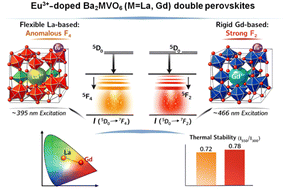
Eu3+-activated double perovskites have attracted increasing attention as red-emitting phosphors owing to their compositional tunability and structurally versatile host lattices. In this work, Ba2La1−xVO6:xEu3+ and Ba2Gd1−xVO6:xEu3+ (x = 0 and 2.5–30 mol%) phosphors were synthesized via a solid-state reaction route and systematically investigated to elucidate host-dependent luminescence behavior. X-ray diffraction combined with Rietveld refinement confirmed single-phase orthorhombic Pnma symmetry for both systems, with the La-based host exhibiting a more flexible and polarizable lattice, while the Gd-based host forms a more compact and rigid framework. Distinct host-dependent microstructural features are observed by scanning electron microscopy (SEM) for the La-based and Gd-based phosphors. X-ray photoelectron spectroscopy (XPS) was further employed to verify the elemental composition and the trivalent oxidation state of Eu ions in representative high-doping compositions. Photoluminescence studies reveal pronounced differences in emission characteristics: Ba2LaVO6:Eu3+ stabilizes an abnormal near-UV-excited 5D0 → 7F4-dominated orange-red emission with high dopant tolerance up to 30 mol% Eu3+, whereas Ba2GdVO6:Eu3+ exhibits the conventional 5D0 → 7F2-dominated red emission with earlier concentration quenching beyond 15 mol%. Temperature-dependent photoluminescence measurements further reveal distinct thermal quenching behaviors, reflected in different quenching onsets and half-intensity temperatures (T0.5), which are closely linked to the lattice rigidity of the two hosts. CIE analysis shows that Ba2LaVO6:Eu3+ emits orange-red light with moderate color purity due to enhanced 5D0 → 7F4 emission, whereas Ba2GdVO6:Eu3+ produces deeper red emission dominated by the 5D0 → 7F2 transition. Overall, this comparative study establishes a clear structure–rigidity–luminescence correlation in Eu3+-activated Ba2MVO6 (M = La, Gd) phosphors, providing fundamental insight into host-controlled emission tuning in double-perovskite systems.
 Please wait while we load your content...


