


 PLATFORM UPDATE:


Boosting elemental mercury capture via an iodine-mediated pathway over a ternary BiOI-MnOx-TiO2 catalyst
 *b
and
Anchao
Zhang
c
*b
and
Anchao
Zhang
c
Abstract
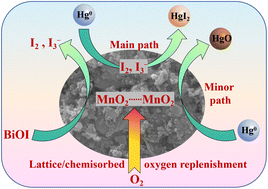
Elemental mercury (Hg0) emission from coal combustion flue gas poses significant environmental and health risks due to its high volatility, persistence, and toxicity. In this study, a novel ternary BiOI-MnOx-TiO2 (BiMnTi) composite catalyst was successfully synthesized via a simple three-step method for efficient Hg0 removal under dark conditions. The composite catalysts were characterized by SEM-EDS, HRTEM, XRD, H2-TPR, N2 adsorption–desorption, FTIR, XPS, and EPR. The BiOI-MnOx-TiO2 composite exhibited superior Hg0 removal efficiency (>97%) over a wide temperature range of 50–200 °C, and showed excellent resistance to SO2 and NO poisoning. Characterization results confirmed that the introduction of BiOI effectively increased the proportion of Mn4+ content and surface chemisorbed oxygen (Oβ) and promoted the formation of oxygen vacancies. XPS and H2-TPR analyses further demonstrated enhanced electron transfer between BiOI and MnOx-TiO2, as well as improved redox properties. Mechanistic studies revealed that the synergistic interaction between BiOI and MnOx-TiO2 facilitated electron transfer at the interface, promoting the oxidation of I− to active iodine species, which subsequently reacted with adsorbed Hg0 to form stable HgI2. This work provides a promising strategy for designing efficient and sulfur-resistant catalysts for Hg0 removal in non-photocatalytic environments.
 Please wait while we load your content...


