


 PLATFORM UPDATE:


Electrochemical synthesis of polyaniline–Ni–Co hybrid structures on titanium substrates for ultrahigh-capacitance supercapacitor electrodes

Abstract
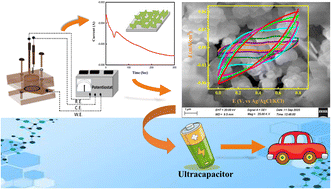
Electrodes are crucial for electrochemical supercapacitor performance, and thin-film electrodes with active layers on conductive substrates enable fast ion transport and efficient charge storage, making them ideal for advanced supercapacitor applications. However, achieving high areal capacitance on titanium current collectors with a simple, binder-free process remains challenging. In this work, we fabricate a binder-free PANI–Ni–Co hybrid film on Ti sheets by sequential electrodeposition of a Ni–Co alloy followed by in situ electrochemical polymerization of polyaniline. XRD, SEM/EDS, and XPS confirm a finely granular Ni–Co scaffold conformally coated by a porous PANI overlayer. Compared with bare Ti and Ni–Co/Ti, the PANI–Ni–Co/Ti electrode exhibits markedly enhanced charge storage in 1.0 M H2SO4. It delivers an areal capacitance of 1230 mF cm−2 at 1 mA cm−2 from GCD and 2819 mF cm−2 at 5 mV s−1 from CV, while retaining 272.5 mF cm−2 at 10 mA cm−2 and ∼11% of its low-rate capacitance at 200 mV s−1. Notably, the electrode shows good cycling durability, retaining 81.8% of its initial capacitance after 1000 GCD cycles, and post-cycling CV profiles recorded in the used and refreshed electrolytes remain essentially unchanged, indicating preserved electrochemical integrity. The Ragone analysis shows energy densities up to 0.11 mWh cm−2 at 0.4 mW cm−2, decreasing to 0.025 mWh cm−2 at 4.0 mW cm−2. EIS reveals reduced solution and charge-transfer resistances and near-ideal capacitive behavior for the hybrid electrode. This simple, room temperature, all electrochemical strategy provides a scalable route to high-areal-capacitance Ti-based electrodes for miniaturized supercapacitors, which are suitable for powering or buffering low-power wearable and microelectronic devices.
 Please wait while we load your content...


