


 PLATFORM UPDATE:


PAR-intercalated Mg/Al layered double hydroxide for efficient adsorption of acid fuchsin: experimental study and molecular docking insights

Abstract
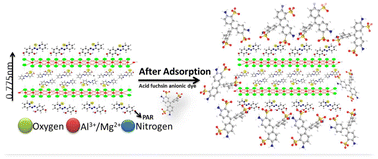
This study systematically investigated the adsorptive removal of acid fuchsin (AF), an anionic dye, from aqueous solutions using a 4-(2-pyridylazo)resorcinol-intercalated magnesium/aluminum layered double hydroxide (PAR-Mg/Al LDH). The composite was successfully synthesized and characterized by FTIR, XRD, SEM, EDX, and XPS. Batch adsorption experiments demonstrated that PAR intercalation significantly enhanced the adsorption performance compared to pristine Mg/Al LDH. Key parameters influencing the adsorption process, including contact time, initial dye concentration, pH, and temperature, were systematically optimized. The adsorption isotherm data were best described by the Langmuir model, indicating monolayer adsorption with a high maximum capacity of 568.18 mg g−1. Kinetic studies revealed that the adsorption process followed the pseudo-second-order model, with excellent agreement between experimental and calculated adsorption capacities. Further kinetic analysis using intraparticle diffusion and Boyd models demonstrated that the adsorption process proceeds via a multi-step mechanism, where external mass transfer dominates the initial stage, followed by intraparticle diffusion at later stages. The PAR-Mg/Al LDH composite also exhibited good reusability over five consecutive adsorption–desorption cycles, maintaining high removal efficiency. These findings highlight the effectiveness of PAR-Mg/Al LDH as a promising adsorbent for the removal of anionic dyes from aqueous environments.
 Please wait while we load your content...


