


 PLATFORM UPDATE:

Atomic perspective elucidates mixed alcohol synthesis from syngas on bilayered (K)/MoS2 catalysts
 *a
Ruihan
Wang,
a
*a
Ruihan
Wang,
a
Abstract
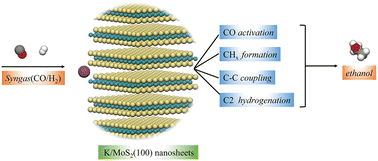
Syngas serves as a crucial link between non-petroleum-based carbon resources and commodity chemicals. Among various conversion routes, the catalytic transformation of syngas into ethanol and other mixed alcohols represents a highly attractive option. K-modified MoS2 systems exhibit notable activity and selectivity in low-carbon alcohol synthesis. To elucidate the correlation between product selectivity and catalyst structure, and to design efficient catalysts for the synthesis of specific single products, density functional theory (DFT) was employed to explore the transition states of elementary steps involved in syngas conversion to mixed alcohols on bilayer (K)/MoS2 catalysts. The results indicate that CO hydrogenation on the S-edge sites of the MoS2(100) facet mainly yields C1 species, whereas ethanol is primarily produced at the Mo-edge sites. Moreover, K doping enhances CO activation and C–C coupling at the Mo-edge. The most favorable pathway for ethanol synthesis at the Mo-edge is identified as CO → HCO → CHOH → CH → CHCO → CH2CO → CH3CO → CH3CHO → CH3CH2O → CH3CH2OH, with the key step being the hydrogenation of CH3CO to CH3CHO, which requires an energy barrier of 0.73 eV. This work offers comprehensive and valuable guidance for the subsequent modification and design of C–C coupling catalysts.
 Please wait while we load your content...


