


 PLATFORM UPDATE:


Colorimetric sensing of arsenic ions in water using a mixture of p-quinonimine- and p-quinone-functionalized gold nanoparticles
 *a
*a
Abstract
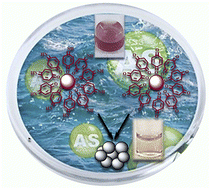
A simple, novel, rapid, selective, and sensitive colorimetric method was demonstrated for the successful sensing of arsenic ions in water using a colloidal mixture of equal volumes (1 : 1) of separately synthesized p-quinonimine- and p-quinone-functionalized gold nanoparticles (AuNPs). The intensity of the surface plasmon resonance absorption maxima of the colloidal mixture of AuNPs was found to decrease with increasing concentrations of As(III) ions irrespective of the pH of the solution. Using the same colloidal mixture, the sensing of As(V) was also successfully performed after chemically reducing it to As(III) using SnCl2 and KI in a concentrated HCl medium. A linearity range of up to 0.035 mM was recorded for the 1 : 1 colloidal mixture of AuNPs diluted with the same volume of water at pH 7–8 towards the detection of As(III) ions. The change in relative absorption with the change in the concentration of As(III) ions, i.e., sensitivity, was calculated to be ∼16.5 mM−1, and the limit of detection of ∼2.5 × 10⁻³ mM was computed from the equation 3σ/slope (σ is the standard deviation of the blank signal). The limit of detection, that is determined higher than the WHO recommended limit (0.133 × 10⁻³ mM), can be extended by pre-concentration of the water sample through simple evaporation of a larger volume of water. The response towards As(III) ions was found to be selective over the other tested ions, such as F−, Cl−, Br−, I−, HCO3−, SO42−, PO43−, CO32−, NO3−, NO2−, Ca2+, Mg2+, K+, Fe2+, Fe3+, Sn2+, Sn4+, Al3+, and Cr3+, and biomolecules, such as fructose, sucrose, lactose, uric acid, ascorbic acid, and dopamine. An immediate visual decolorization was also detected by naked eye for 1 mL of 10 times diluted 1 : 1 colloidal mixture of AuNPs towards 0.5 mL aqueous As(III) solution of ∼44 × 10−3 mM. The sensing mechanism was proposed by considering the agglomeration of AuNPs into micro-particles due to destabilization caused by the As(III) ions. The sensing technique was verified to have a reliable accuracy level of ∼97% ± 2% towards the detection of total As concentration in an underground water sample.
 Please wait while we load your content...


