


 PLATFORM UPDATE:


Analyzing the potential of waste cooking oils as biolubricants for electric vehicles†
 b
and
Sougata
Roy
*a
b
and
Sougata
Roy
*a
Abstract
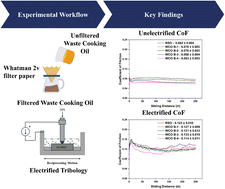
The transition from internal combustion engines (ICE) to electric vehicles (EVs) has pushed the search for new sustainable lubricants that can withstand relevant lubrication challenges, like high torque loads and stray currents in drivetrains, which can accelerate oxidation and increase component wear, posing a critical challenge for electric powertrain components. Conventional Automatic Transmission Fluids like ATF III and ATF V have shown different wear mechanisms and coefficient of friction (CoF) trends in the presence of simulated stray currents. While many studies have focused on vegetable oils as biobased oils, waste cooking oils (WCO) offer a more sustainable alternative, yet their performance under electrified conditions is yet to be explored. In this study, four WCO samples were collected from different sources and evaluated against regular soybean oil (RSO) through structural, physico–chemical, and tribological analysis under electrified and unelectrified sliding conditions. Structural analyses using FTIR, 1H/13C NMR, GC-MS, and CMS confirmed the triglyceride integrity across all samples, with differences in fatty acid composition influencing physicochemical properties. WCO B-4, with the lowest unsaturation of 3.43 C![[double bond, length as m-dash]](https://www.rsc.org/images/entities/char_e001.gif) C bonds/triglyceride, exhibited the highest viscosity. At the same time, WCO B-2 showed higher oxidation resistance due to high oleic acid content (66.2%) and a lower degree of unsaturation of 3.73 compared to other WCOs, which reduced reactive oxidation sites. WCO B-2 exhibited the lowest cloud and pour points, which can be attributed to the presence of low saturated fatty acids in triglyceride molecules, and is dominated by monounsaturated fatty acids. Tribological testing on aluminum–steel contacts showed that, under unelectrified conditions, WCO B-3 and B-4 resulted in reduced average coefficients of friction by 18% and 23%, respectively, and had lower average wear depth compared to RSO. Under electrified conditions, all batches of lubricants exhibited increased wear and oxidation, yet WCO B-4 maintained the lowest wear depth despite frictional instability. Additional surface characterization via high-resolution microscopy and spectroscopy techniques confirmed more severe oxidation and lower material transfer under current, underscoring the degradation risk in electrically stressed contacts.
C bonds/triglyceride, exhibited the highest viscosity. At the same time, WCO B-2 showed higher oxidation resistance due to high oleic acid content (66.2%) and a lower degree of unsaturation of 3.73 compared to other WCOs, which reduced reactive oxidation sites. WCO B-2 exhibited the lowest cloud and pour points, which can be attributed to the presence of low saturated fatty acids in triglyceride molecules, and is dominated by monounsaturated fatty acids. Tribological testing on aluminum–steel contacts showed that, under unelectrified conditions, WCO B-3 and B-4 resulted in reduced average coefficients of friction by 18% and 23%, respectively, and had lower average wear depth compared to RSO. Under electrified conditions, all batches of lubricants exhibited increased wear and oxidation, yet WCO B-4 maintained the lowest wear depth despite frictional instability. Additional surface characterization via high-resolution microscopy and spectroscopy techniques confirmed more severe oxidation and lower material transfer under current, underscoring the degradation risk in electrically stressed contacts.
 Please wait while we load your content...


