


 PLATFORM UPDATE:


Fmoc-Phe : Fmoc-Leu supramolecular hydrogels with adaptive antibacterial activity
 ab
Henna
Rahkola,
a
Efstratios D.
Sitsanidis,
a
Tatu
Kumpulainen,
a
Lotta-Riina
Sundberg,
d
Jennifer R.
Hiscock,
c
Mika
Pettersson
a
and
Maija
Nissinen
*a
ab
Henna
Rahkola,
a
Efstratios D.
Sitsanidis,
a
Tatu
Kumpulainen,
a
Lotta-Riina
Sundberg,
d
Jennifer R.
Hiscock,
c
Mika
Pettersson
a
and
Maija
Nissinen
*a
Abstract
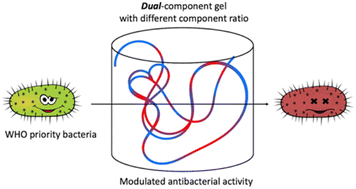
The development of adaptive soft materials offers new opportunities to address the effects of antimicrobial resistance. Fmoc-phenylalanine (Fmoc-Phe) and Fmoc-leucine (Fmoc-Leu) based hydrogels are known to demonstrate antibacterial activity. We now show that by combining these two gelators (Fmoc-Phe and Fmoc-Leu) into a multicomponent hydrogel system, we can tune the antibacterial properties of the resultant hydrogel. This tunable antimicrobial behaviour is achieved by varying the Fmoc-Phe : Fmoc-Leu ratio, which also influences self-assembly and, as a result, the physical properties of the material. We show that changing the component ratio can be used to optimise gelation efficiency and modulate viscoelastic, self-healing and thermoresponsive properties. Spectroscopic analyses reveal that while β-sheet organisation is retained independently of the ratio of gelators supplied, system stability (increasing material softness) is observed as a direct result of the proportion of the gelator that remains unassembled in the sol of the resultant hydrogel. Antibacterial assays conducted against clinically relevant Gram-positive and Gram-negative pathogens demonstrate formulation-dependent responses, with Gram-positive strains showing the greatest susceptibility. From these data, we can determine a structure–activity relationship, which demonstrates the importance of compositional tuning as a simple and effective strategy for designing peptide-based hydrogels with tailorable physical, material and antimicrobial properties.
 Please wait while we load your content...


