


 PLATFORM UPDATE:


Interface-engineered MoS2 heterostructures: from construction strategies to energy and photovoltaic applications
 †a
†a
Abstract
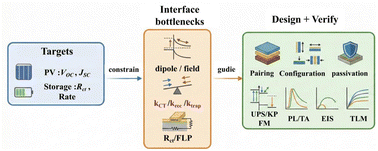
Two-dimensional MoS2 is a versatile semiconductor for optoelectronic and energy technologies, yet device performance is often constrained not by intrinsic layer properties but by interfacial bottlenecks such as energy-level misalignment, inefficient charge transfer, trap-mediated losses, and contact resistance. Recent progress in MoS2-based heterostructures demonstrates that nominal band diagrams alone are insufficient to predict outcomes; instead, device metrics emerge from a coupled interplay of energy-landscape reconstruction via interfacial dipoles and built-in fields, kinetic competition among charge transfer, recombination and trapping (kCT/krec/ktrap), and parasitic or contact limitations. Building on this mechanism-to-metrics view, this review summarises scalable construction strategies for vertical, lateral and mixed-dimensional MoS2 heterostructures, and organises interface types as actionable design levers spanning band-alignment classes, contact archetypes and bonding motifs. We further formalise a “backward design” route that starts from the target figure of merit, translates it into experimentally verifiable interfacial requirements including band offsets, dipole steps, PL/TA signatures, Rct and contact resistivity, and then selects material pairing and geometry accordingly. To improve comparability beyond case-by-case reporting, a function–coupling–pairing summary and a minimum measurement checklist are provided. Photovoltaic and energy-storage case studies illustrate how Type-II alignment plus built-in fields suppress recombination and enhance extraction, while ion-permeable, strain-accommodating, Fermi-level-tuned interfaces accelerate charge-storage kinetics and stabilise cycling. Finally, we highlight remaining challenges in wafer-scale defect control, quantitative interface metrology, long-term stability and encapsulation, and interoperable data reporting toward manufacturable MoS2 heterostructure technologies.
- This article is part of the themed collection: 2026 Reviews in RSC Advances
 Please wait while we load your content...


