Issue 13, 2026, Issue in Progress

Comprehensively investigating pharmacokinetics and metabolic fate of andrographolide in rats by liquid chromatography/mass spectrometry-based approach

Abstract

Andrographolide, a natural labdane diterpenoid lactone isolated from Andrographis paniculata, possesses diverse pharmacological properties such as anti-tumor, anti-inflammatory, antiviral, and immunomodulatory activities, rendering it a promising candidate for therapeutic development. In this study, pharmacokinetic profiles, excretion features, and metabolism of andrographolide were systematically investigated in rats using a liquid chromatography/mass spectrometry (LC/MS)-based approach. Following intravenous and oral administration, andrographolide exhibited high elimination and moderate bioavailability. Excretion study revealed that less than 5% of the administered dose was eliminated in its parent form in urine and feces. Metabolic profiling identified a total of 39 analytes, among which 34 were sulfated conjugates—establishing sulfation as the most structurally diverse metabolic pathway of andrographolide in rats. A novel MS/MS fragmentation workflow was established, which enabled the unambiguous discrimination of four sulfation modification sites: O-sulfation at the C3 and C19 positions, and C-sulfation at the C12 and C14 positions. Collectively, this comprehensive study delineates the complete in vivo disposition of andrographolide in rats and clarifies the site-specific sulfation rules of its metabolites.
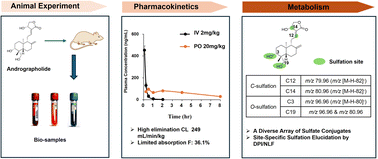
Graphical abstract: Comprehensively investigating pharmacokinetics and metabolic fate of andrographolide in rats by liquid chromatography/mass spectrometry-based approach

Supplementary files

Article information

Article type
Paper
Submitted
10 Nov 2025
Accepted
09 Feb 2026
First published
27 Feb 2026
This article is Open Access
Creative Commons BY-NC license

RSC Adv., 2026,16, 11348-11360

Comprehensively investigating pharmacokinetics and metabolic fate of andrographolide in rats by liquid chromatography/mass spectrometry-based approach

X. Sun, Y. Zhang, Z. Shang, L. Dou, T. Wang, J. Qiu and S. Chen, RSC Adv., 2026, 16, 11348 DOI: 10.1039/D5RA08654J

This article is licensed under a Creative Commons Attribution-NonCommercial 3.0 Unported Licence. You can use material from this article in other publications, without requesting further permission from the RSC, provided that the correct acknowledgement is given and it is not used for commercial purposes.

To request permission to reproduce material from this article in a commercial publication, please go to the Copyright Clearance Center request page.

If you are an author contributing to an RSC publication, you do not need to request permission provided correct acknowledgement is given.

If you are the author of this article, you do not need to request permission to reproduce figures and diagrams provided correct acknowledgement is given. If you want to reproduce the whole article in a third-party commercial publication (excluding your thesis/dissertation for which permission is not required) please go to the Copyright Clearance Center request page.

Read more about how to correctly acknowledge RSC content.

Social activity

Spotlight

Advertisements