


 PLATFORM UPDATE:


Cephalexin-loaded polyvinyl alcohol/graphene oxide thin films as antibacterial wound dressing
 *a
Soroush
Yousefi,
b
Safa Momeni
Badeleh,
c
Hossein
Abdollahi,
d
Morteza
Abazari
*e
and
Abdolhmid
Alizadeh
f
*a
Soroush
Yousefi,
b
Safa Momeni
Badeleh,
c
Hossein
Abdollahi,
d
Morteza
Abazari
*e
and
Abdolhmid
Alizadeh
f
Abstract
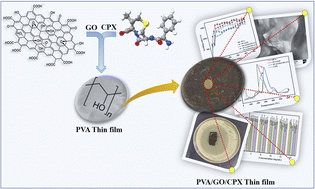
In the present study, biodegradable polyvinyl alcohol/graphene oxide-based thin films were prepared as a topical drug delivery system via the solvent casting method for the loading and controlled release of the antibacterial drug cephalexin. Results showed that all the fabricated thin films had highly uniform and smooth-surface textures. The chemical structure and crystallinity of the samples were investigated by FTIR spectroscopy and XRD analysis, and the SEM and EDX techniques revealed the successful loading and uniform dispersion of cephalexin within the prepared films. Investigations on the thermal properties of the samples indicated that the thermal stability of the samples increased with the addition of graphene oxide, while it decreased with the addition of cephalexin. Water contact angle measurements revealed an increase in the hydrophobicity of thin films upon the addition of graphene oxide and cephalexin, and the final scaffolds displayed a contact angle of 104.6° ± 1.72°. The fabricated thin films also displayed pH-dependent degradation, swelling, and release behaviors in PBS solutions of pH 7.4 and 5.5. Moreover, a two-stage release profile was observed for drug-containing films during the liberation of cephalexin into release media. Additionally, the drug-containing films exhibited potent antibacterial activity against both Gram-positive and Gram-negative bacteria. Evaluating the cytocompatibility of the samples revealed desired cell viability up to 64 mg mL−1 during 24 h, and the toxic effect of the samples was increased in a concentration-dependent manner.
 Please wait while we load your content...


