


 PLATFORM UPDATE:


Distribution of polychlorinated organic by-products during the hydrolytic oxidation of chlorinated volatile organic pollutants over Pd–Ni-based catalysts
Abstract
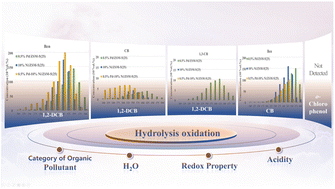
Hydrolytic oxidation has been proven to effectively minimize the formation of polychlorinated organic by-products during the catalytic degradation of chlorinated volatile organic pollutants (CVOCs). In this study, we delved into the distribution characteristics of chlorinated organic by-products that occur during the hydrolytic oxidation of chlorobenzene, 1,2-dichlorobenzene, and o-chlorophenol. When it came to the catalytic degradation of chlorobenzene and 1,2-dichlorobenzene, we detected a small quantity of chlorinated organic by-products. Notably, both the types and concentrations of these by-products exhibited a volcano-type trend with increasing temperature, which was attributed to the competition between CVOC degradation and by-product formation at different temperature stages. On the other hand, during the catalytic degradation of o-chlorophenol, no aromatic chlorinated organic by-products were found at all. The 0.5% Pd–10% Ni/ZSM-5(25) catalyst stood out with the best hydrolytic oxidation activity. Specifically, the complete conversion temperatures for o-chlorophenol, chlorobenzene, and 1,2-dichlorobenzene were 250 °C, 375 °C, and 425 °C respectively. We employed various analytical techniques such as XRD, XPS, FTIR, H2O-TPD, and pyridine-FTIR to explore the impact of the structure and surface properties of modified ZSM-5 zeolites on catalytic activity. The study revealed that the catalytic activity mainly stems from the surface acidity, active protons and the redox properties of the catalyst.
 Please wait while we load your content...


