


 PLATFORM UPDATE:


A Ru(ii)-arene complex with promising anti-Aβ activity

Abstract
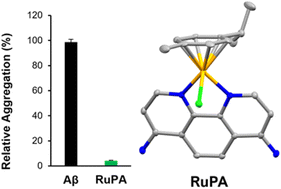
Agents that target the amyloid-beta (Aβ) peptide associated with Alzheimer's disease have seen renewed interest following recent the clinical success of monoclonal antibody therapeutics. Metal complexes are particularly promising for development, given their relative ease of preparation and modular scaffold. Additionally, Aβ has been shown to coordinate endogenous metal ions in solution, while metal complexes can exploit this affinity, thereby modulating the aggregation of the peptide. Herein, a series of five ruthenium(II)-arene complexes with 1,10-phenanthroline (phen) ligands were prepared and studied for their respective abilities to impact the aggregation of Aβ. Overall, the complex with the 4,7-diamino-1,10-phenanthroline ligand (RuPA) had the greatest impact on Aβ aggregation. Furthermore, this complex also displayed interactions with imidazole in aqueous media, which suggests that coordinate interactions with the peptide occur via histidine. Lastly, RuPA also demonstrated exceptional biocompatibility towards two neuronal cell lines and displayed a lower affinity to human serum albumin in comparison to ibuprofen. Taken together, the primary amine groups on the phen ligand enhanced the anti-Aβ ability of the complex, which is an important structure–activity relationship.
 Please wait while we load your content...


