


 PLATFORM UPDATE:


Chemical tailoring of heteroatom (P, S, Si) doping of COF-PEDOT for adsorption of paracetamol: perspective from DFT studies

Abstract
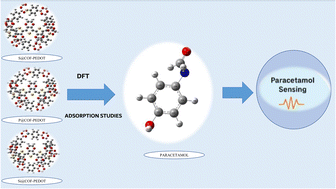
The growing occurrence of pharmaceutical contaminants in aquatic systems has intensified the demand for advanced nanostructured materials capable of selective adsorption and removal of such pollutants. Paracetamol, a commonly used analgesic and antipyretic drug, is frequently detected in wastewater and poses severe ecological and health risks when accumulated in the water bodies and the soil. In this study, density functional theory (DFT) calculations were employed to investigate the structural, electronic, and adsorption behaviors of phosphorus (P), sulfur (S), and silicon (Si) doped COF-PEDOT frameworks for paracetamol adsorption. All geometries were optimized using the PBE0-D3/6-311G(d) basis set. The optimized structures exhibited minimal distortion after adsorption, indicating stable interactions between the adsorbate and the doped surfaces. Density of states (DOS) analysis revealed that heteroatom incorporation enhanced the electronic activity and reactivity of the complexes, while frontier molecular orbital (FMO) analysis showed a notable narrowing of the energy gap, confirming improved electron transfer capability. The ionization potential values (5.29–5.44 eV) remained within the range of moderately stable adsorbents. Natural bond orbital (NBO) analysis indicated that phosphorus doping produced the highest orbital stabilization energies, suggesting stronger donor–acceptor interactions. Adsorption energy calculations yielded negative values for all systems, confirming exothermic and thermodynamically favorable adsorption processes. Furthermore, quantum theory of atoms in molecules (QTAIM) and non-covalent interaction (NCI) analyses demonstrated the presence of weak but stable van der Waals and hydrogen-bond interactions governing paracetamol adsorption. The results demonstrate that tailored heteroatom doping can effectively tune the electronic and adsorption characteristics of COF-PEDOT frameworks. The P-, S-, and Si-doped systems exhibit enhanced sensitivity, stability, and reversibility, making them promising candidates for the selective adsorption of paracetamol from pharmaceutical contaminants in aquatic environments.
 Please wait while we load your content...


