


 PLATFORM UPDATE:


Paraben adsorption on carbon-based 2D nanomaterials: molecular mechanisms and implications for environmental pollutant detection†

Abstract
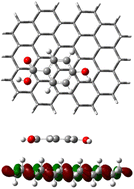
Parabens, widely used as a preservative in personal care products, have emerged as environmental micropollutants due to their persistence and endocrine disrupting potential. Insights into their interactions with nanomaterials are crucial for the rational design of effective adsorbents. In the current study, we investigated the adsorption behaviour of various paraben derivatives on carbon-based two-dimensional nanomaterials by employing a density functional theory approach. We evaluated the interactions of paraben and its alkyl derivatives with graphene and graphane, two representative carbon-based 2D nanomaterials. These substrates which differ significantly in their electronic structure and surface chemistry were used to examine the adsorption mechanisms. Our results reveal that while graphene exhibits stronger π–π interactions due to its delocalized electronic system, graphane, despite being a saturated hydrocarbon, also forms stable complexes. The strength of the binding increases as the size of the alkyl chain increases in the paraben derivatives, indicating the role of molecular size in adsorption enhancement. We also employed charge transfer calculations, topological analysis, energy decomposition analysis to further understand the nature of the interactions. This study offers molecular-level insight into paraben adsorption on nanomaterials and provides a theoretical basis for designing two-dimensional materials for selective detection and removal of organic pollutants.
 Please wait while we load your content...


