


 PLATFORM UPDATE:


Optical anisotropy induced by ultra-strong interfacial coupling in CVD-grown WSe2/ReSe2 vertical heterostructures

Abstract
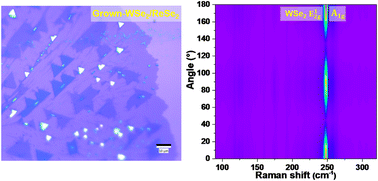
Integrating high-mobility isotropic transition metal dichalcogenides (TMDs) with anisotropic layered materials offers an ideal strategy to break through the application bottleneck of a single material. Van der Waals assembly has proven a direct route to realize anisotropic heterostructures for polarization-sensitive electronics and photoelectronics, yet conventional methods typically rely on artificial stacking of TMD materials with varying symmetries. This approach not only limits the efficiency of fabrication but also yields poor interfacial coupling, resulting in weak anisotropy in heterostructures. Here, we directly grow high-quality monolayer WSe2 on low-symmetry monolayer ReSe2 to fabricate WSe2/ReSe2 vertical heterostructures by NaCl-assisted chemical vapor deposition (CVD). Angle-resolved polarization Raman spectroscopy confirms that the isotropic WSe2 exhibits pronounced in-plane optical anisotropy upon combining with low-symmetry ReSe2, which is attributed to the intrinsic symmetry breaking of WSe2 induced by ultra-strong interlayer coupling between WSe2 and ReSe2. Notably, the pronounced photoluminescence (PL) quenching and shortened exciton lifetime of WSe2 provide direct evidence of ultra-strong interfacial coupling in the CVD-grown WSe2/ReSe2 vertical heterostructures. Consequently, this study demonstrates the pivotal role of interfacial coupling in achieving high-degree anisotropy in TMD heterostructures, offering a new design paradigm for polarization-sensitive electronics and optoelectronics.
 Please wait while we load your content...


