


 PLATFORM UPDATE:


Tunable dispersion of cobalt oxide nanoclusters grafted on mesoporous SBA-15 for efficient pharmaceutical removal from wastewater
 c
Abdelkrim
El Kadib
*be
c
Abdelkrim
El Kadib
*be
Abstract
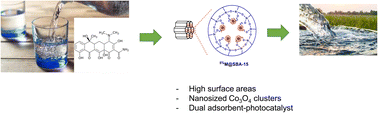
Pharmaceutical contaminants are an emerging threat, driving antibiotic resistance and environmental risk. Here, we harness the high surface area and tunable chemistry of mesoporous SBA-15 silica to engineer hybrid adsorbents by confining ultra-small metal oxide clusters (<1 nm; NiO: 0.47 ± 0.15 nm, Co3O4: 0.63 ± 0.17 nm, Fe2O3: 0.73 ± 0.18 nm) within its mesostructured network. Consistent with its strong Lewis acidity, cobalt oxide-loaded SBA-15 exhibited exceptional tetracycline removal efficiency, outperforming pristine SBA-15, aminopropyl/mercaptopropyl-functionalized silicas, bulk cobalt oxide, and other nanomaterials. Through benchmarking and accurate comparison, several key points can be made: (i) residual pluronic was pivotal for stabilizing the burst and keeping the metallic phase well dispersed and with an ultra-small size, which consequently enabled the retention of the mesostructure, (ii) thermal annealing treatment was essential for strengthening the interfacial grafting and for structural integrity, (iii) surface polarity imparted by terminal hydroxyl groups promoted strong interaction with the pharmaceutical pollutant. The photoactivatable Co–O–Si sites, reached through atomic cobalt dispersion on the silica matrix, provide an additional means for photo-oxidation, enabling near-complete degradation of highly concentrated tetracycline (10−3 mol L−1) under visible light. Mechanistic studies reveal the involvement of hole-mediated surface reactions in the photo-triggered degradation pathway. This multifunctional, cobalt oxide decorated mesostructured SBA-15-type silica hybrid offers a promising platform for advanced water purification technologies.
 Please wait while we load your content...


