Issue 7, 2026, Issue in Progress

A green and sustainable approach using Thuja occidentalis-mediated Fe3O4 QDs decorated on rGO NSs for enhanced photocatalytic degradation of antibiotics

Abstract

Emerging pharmaceutical contaminants such as antibiotics, personal care products, and anti-inflammatory drugs have become major environmental concerns due to their persistence and toxicity. In this study, Fe3O4 quantum dots supported on reduced graphene oxide nanosheets (Fe3O4 QDs–rGO NSs) were successfully synthesized via a green hydrothermal route using Thuja occidentalis leaf extract as a natural reducing and capping agent. The resulting nanocomposites (NCs) exhibited a high surface area (168 m2 g−1) and mesoporous structure (average pore size ≈14 nm), favouring pollutant adsorption and charge separation. Under visible-light irradiation, the Fe3O4 QDs–rGO NSs demonstrated superior photocatalytic performance toward pharmaceutical contaminants, achieving degradation efficiencies of 94.5% for ciprofloxacin (CIP), 76.2% for ibuprofen (IBU), and 90.7% for tetracycline (THC) within 120 min at an optimum catalyst dose of 5 mg and neutral pH ≈ 7. The apparent first-order rate constants (k) were 0.024, 0.017, and 0.012 min−1 for CIP, IBU, and THC, respectively. The nanocomposite retained over 90% of its photocatalytic efficiency after five reuse cycles, confirming its excellent stability and recyclability. The enhanced activity is attributed to the synergistic interaction between Fe3O4 QDs and rGO, which promotes efficient charge carrier separation and radical generation. These results highlight the potential of bioinspired Fe3O4 QDs–rGO NSs as an efficient, sustainable photocatalyst for wastewater remediation applications.
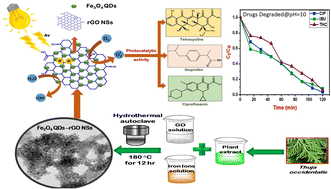
Graphical abstract: A green and sustainable approach using Thuja occidentalis-mediated Fe3O4 QDs decorated on rGO NSs for enhanced photocatalytic degradation of antibiotics

Transparent peer review

To support increased transparency, we offer authors the option to publish the peer review history alongside their article.

View this article’s peer review history

Article information

Article type
Paper
Submitted
18 Oct 2025
Accepted
15 Dec 2025
First published
02 Feb 2026
This article is Open Access
Creative Commons BY-NC license

RSC Adv., 2026,16, 6521-6538

A green and sustainable approach using Thuja occidentalis-mediated Fe3O4 QDs decorated on rGO NSs for enhanced photocatalytic degradation of antibiotics

A. Potbhare, R. Madankar, S. Tripathy, P. Bhilkar, A. Kahate, S. Somkuwar, L. N. Wei Tat, A. Abdala, R. Adhikari and R. Chaudhary, RSC Adv., 2026, 16, 6521 DOI: 10.1039/D5RA07996A

This article is licensed under a Creative Commons Attribution-NonCommercial 3.0 Unported Licence. You can use material from this article in other publications, without requesting further permission from the RSC, provided that the correct acknowledgement is given and it is not used for commercial purposes.

To request permission to reproduce material from this article in a commercial publication, please go to the Copyright Clearance Center request page.

If you are an author contributing to an RSC publication, you do not need to request permission provided correct acknowledgement is given.

If you are the author of this article, you do not need to request permission to reproduce figures and diagrams provided correct acknowledgement is given. If you want to reproduce the whole article in a third-party commercial publication (excluding your thesis/dissertation for which permission is not required) please go to the Copyright Clearance Center request page.

Read more about how to correctly acknowledge RSC content.

Social activity

Spotlight

Advertisements