


 PLATFORM UPDATE:

Cyclic polyglycolide by means of metal acetylacetonates
 a
Jana
Falkenhagen
c
and
a
Jana
Falkenhagen
c
and
Abstract
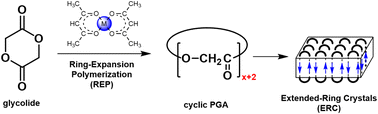
Glycolide was polymerized in bulk at 160 °C using various metal acetylacetonates as catalysts. Zirconium acetylacetonate was particularly efficient, enabling rapid polymerization even at 130 °C. The formation of cyclic poly(glycolic acid) (PGA), most likely via a ring-expansion polymerization (REP) mechanism, was proven by matrix-assisted laser desorption/ionization time-of-flight (MALDI-TOF) mass spectrometry. Depending on the polymerization conditions, the formation of even-numbered cycles was favored to varying degrees. Number-average molecular weights (Mn) in the range of 2000–3500 g mol−1 were achieved with dispersities below 2.0. Wide-angle X-ray scattering (WAXS) powder patterns showed that the crystal lattice was the same as that of known linear PGAs, regardless of the Mn values. These patterns enabled a comparison of crystallinities with values derived from DSC measurements.
 Please wait while we load your content...


