


 PLATFORM UPDATE:


Recent progress in the preparation and environmental applications of functionalized adsorbent hydrogel: a review
 a
Muneer
Baata,
b
Fawziah
Alhajri,
a
A. M.
Elbasiony,
c
Mohammed S.
Almoiqli,
b
Mohamed
Madani
a
and
Mohamed Mohamady
Ghobashy
*d
a
Muneer
Baata,
b
Fawziah
Alhajri,
a
A. M.
Elbasiony,
c
Mohammed S.
Almoiqli,
b
Mohamed
Madani
a
and
Mohamed Mohamady
Ghobashy
*d
Abstract
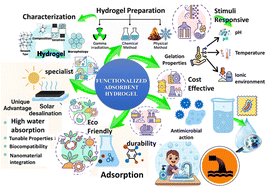
This review highlights recent advancements in the preparation and environmental applications of functionalized adsorbent hydrogels, with a focus on their role in addressing global water pollution and scarcity. Hydrogels, with their unique three-dimensional crosslinked structures and exceptional water retention capabilities, have emerged as versatile materials for water purification. The review encompasses various synthesis methods, including chemical cross-linking and radiation-induced polymerization, and examines their mechanisms for pollutant removal, including adsorption, ion exchange, electrostatic interactions, and photocatalytic degradation. Additionally, integrating nanomaterials into hydrogels enhances their mechanical properties and contaminant-removal efficiency. The review also discusses innovative applications, including solar-driven water remediation, microbial inactivation, and simultaneous water and power generation. These advancements position hydrogels as sustainable and efficient solutions for global water security challenges.
 Please wait while we load your content...


