


 PLATFORM UPDATE:


Fabrication of a Z-scheme 3D/2D MgIn2S4/BiOBr heterojunction for enhanced photocatalytic removal of ciprofloxacin in water

Abstract
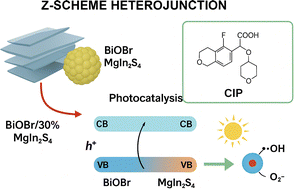
Engineered Z-scheme semiconductor systems offer promising strategies for the removal of antibiotics from contaminated water. Here, we report the fabrication of a Z-scheme heterojunction by coupling two-dimensional (2D) bismuth oxybromide (BiOBr) nanosheets with three-dimensional (3D) magnesium indium sulfide (MgIn2S4) nanoflowers to enhance the photocatalytic degradation of ciprofloxacin (CIP) under visible light irradiation. The BiOBr/MgIn2S4 composite was synthesized through a simple in situ hydrothermal method, and comprehensive characterization techniques, including X-ray diffraction (XRD), field-emission scanning electron microscopy (FESEM), and transmission electron microscopy (TEM), confirmed the successful formation of a highly intimate 2D/3D heterojunction. Among the various composites, the BiOBr/30%MgIn2S4 heterojunction exhibited the highest CIP degradation efficiency, achieving 89.9% within 60 minutes, significantly outperforming the pristine BiOBr (52.6%) and MgIn2S4 (58.5%) under visible light. This remarkable enhancement in photocatalytic activity is attributed to the synergistic effects of improved visible light absorption and, more critically, efficient charge separation, as evidenced by photoelectrochemical measurements and photoluminescence spectroscopy. X-ray photoelectron spectroscopy (XPS), Mott–Schottky analysis, and radical trapping experiments provided conclusive evidence for a Z-scheme charge transfer mechanism. This mechanism facilitates the spatial separation of charge carriers, where oxidative holes in the valence band of BiOBr are preserved for direct CIP oxidation and hydroxyl radical (˙OH) generation, while the reductive electrons in the conduction band of MgIn2S4 drive the generation of superoxide radicals (O2˙−). Moreover, the composite demonstrated excellent reusability, maintaining its performance over five consecutive cycles. These findings offer valuable insights into the design and optimization of efficient 2D/3D Z-scheme photocatalysts for advanced environmental remediation applications, particularly in the removal of organic contaminants from water.
 Please wait while we load your content...


