


 PLATFORM UPDATE:


MnFe aminoclay as a novel catalyst: structural characterization and potential for catechol detection

Abstract
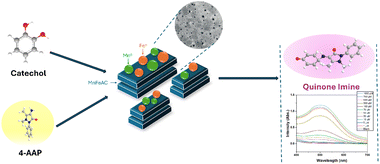
The development of enzyme-mimicking nanomaterials offers a promising route toward sensitive, stable, and cost-effective detection of phenolic compounds. In this study, MnFe hybrid aminoclay (MnFeAC) was synthesized and systematically characterized by XRD, XPS, SEM, TEM, and elemental mapping to confirm its amorphous structure, homogeneous elemental distribution, and mixed-valence states of Mn and Fe that underpin its catalytic activity. The MnFeAC material exhibited oxidase-like properties, enabling the oxidation of catechol in the presence of 4-aminoantipyrine (4-AAP) with a distinct colorimetric signal at 510 nm. Under optimized conditions, a linear calibration curve was obtained in the range of 1–100 µM with high correlation and sensitivity. A key advantage of our method is that no external H2O2 was required, avoiding issues of toxicity, instability, and handling hazards associated with hydrogen peroxide. Furthermore, the MnFeAC-catalyzed system maintained stable signal intensity without significant interference from H2O2 concentration effects, highlighting its intrinsic oxidase-like activity. While this preliminary study demonstrates a proof-of-concept for MnFeAC as an oxidase mimic for catechol detection, further optimization of nanomaterial composition, reaction conditions, and assay design is needed to improve detection limits and extend the method to broader classes of phenolic pollutants. These findings provide a foundation for developing hybrid aminoclay-based nanozymes as safe and effective sensing platforms for environmental monitoring applications.
 Please wait while we load your content...


