


 PLATFORM UPDATE:


Enhancing hydrogen uptake in TiFe at moderate pressures via rationally designed biomass-derived carbon additives

Abstract
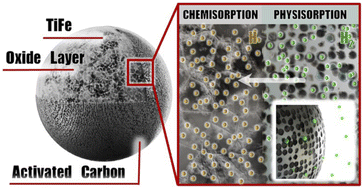
Hydrogen is a promising clean energy carrier, but its widespread use is limited by challenges in safe, efficient, and scalable storage. TiFe alloy is an attractive solid-state hydrogen storage material due to its high capacity and operation under mild conditions, yet its practical performance is hindered by surface oxidation, which impairs hydrogen sorption uptake. A sustainable approach uses activated carbon made from agricultural waste to overcome this limitation. By screening activated carbons produced from three biomass precursors, we identify garlic-peel-derived carbon as an optimal additive, exhibiting an ultrahigh surface area (∼3200 m2 g−1), oxygen-containing functionalities, a predominantly microporous architecture (83%), and high hydrogen uptake (0.99 wt% H2 at 298 K and 100 bar). Incorporation of only 1 wt% of this material into TiFe suppresses oxide formation and increases hydrogen uptake from ∼1.4 to 1.5 wt% under identical conditions. Additionally, molecular dynamics simulations reveal that incorporating a porous activated carbon layer (0.65 nm pores) onto TiFe alloys significantly alters hydrogen distribution by introducing additional sorption sites. This approach improves hydrogen storage and promotes sustainability by converting agricultural waste into a valuable material.
- This article is part of the themed collection: 13th International Conference on Nanomaterials and Advanced Energy Storage Systems special issue
 Please wait while we load your content...


