


 PLATFORM UPDATE:


High-affinity nitrogen-doped graphene quantum dots for selective in vivo and ex vivo detection of amyloid-β plaques in an Alzheimer's disease rat model

Abstract
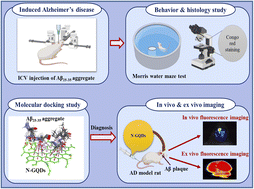
Early and precise detection of the amyloid-β (Aβ) aggregates is a critical factor in understanding Alzheimer's disease (AD) pathology. Current fluorescent probes for detecting Aβ plaques suffer from poor photostability, low selectivity, and ineffective blood–brain barrier (BBB) permeability, hindering in vivo imaging efficacy. Herein, we develop the first demonstration of nitrogen-doped graphene quantum dots (N-GQDs) as multifunctional fluorescent probes enabling sensitive, selective, and real-time in vivo and ex vivo imaging of Aβ aggregates in an AD rat model that overcomes previous limitations. Unlike conventional organic dyes, our N-GQDs combine high photostability with enhanced biocompatibility (cytotoxicity <10% at 250 µg mL−1) and high quantum yield (57.3%). Their nanoscale size (7.4 nm) facilitates efficient BBB penetration and rapid clearance, addressing a major challenge in existing Aβ imaging agents. Nitrogen doping increases the affinity and selective binding interactions of GQDs with Aβ aggregates by introducing active sites and modifying their electronic structure. N-GQDs showed a fluorescence enhancement specifically upon binding to Aβ25–35 aggregates, providing sensitive detection at concentrations as low as 1.6 µM. Molecular docking analysis confirmed a strong and stable interaction (−57.4 kcal mol−1) between N-GQDs and Aβ25–35 aggregates, supporting the observed selectivity. Following intravenous injection of the N-GQDs, the fluorescent intensity in the brain of the AD model rats showed a ∼2-fold increase compared to that of control rats, consistent with ex vivo biodistribution studies. These findings establish N-GQDs as the first graphene-based platform for non-invasive, selective in vivo detection of Aβ plaques, offering them as a diagnostic agent for AD pathology.
 Please wait while we load your content...


