Issue 7, 2026, Issue in Progress

Impact of functionalization linker chemistry on cellulase immobilization: a comparative study of TEOS, APTS, and MPTS functionalized magnetic nanoparticles

Abstract

Magnetic nanobiocatalysts based on Fe3O4 nanoparticles coated with tetraethyl orthosilicate (TEOS) and functionalised with (3-aminopropyl)triethoxysilane (APTS) or (3-mercaptopropyl)trimethoxysilane (MPTS) were developed for cellulase immobilisation and systematically evaluated. Physicochemical characterisation confirmed successful surface modification, while adsorption studies showed that MNPs@TEOS-MPTS achieved the highest immobilisation capacity (qe = 1.06 mg mg−1) with fast kinetics following a pseudo-second-order model, whereas MNPs@TEOS-APTS displayed lower loading (qe = 0.94 mg mg−1) and diffusion-limited behaviour. Enzymatic assays revealed that MNPs@TEOS-APTS exhibited the highest catalytic activity (1.92 U g−1) under optimal conditions (pH 5, 50 °C), but with reduced tolerance to alkaline pH, while MNPs@TEOS-MPTS showed slightly lower initial activity (1.61 U g−1) combined with enhanced thermal resistance and operational stability. Reusability tests highlighted MNPs@TEOS–MPTS as the most robust system, retaining 62% of its initial activity after six cycles, compared to 33% for MNPs@TEOS–APTS and 52% for MNPs@TEOS. Molecular docking analysis supported these findings, indicating higher binding affinity for APTS associated with favourable catalytic orientation, whereas MPTS promoted multiple stabilising interactions that increased conformational rigidity. Overall, the results demonstrate that ligand chemistry critically governs the balance between catalytic efficiency and long-term stability, providing rational guidelines for the design of magnetic nanobiocatalysts tailored to industrial applications.
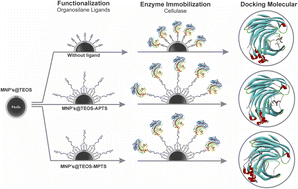
Graphical abstract: Impact of functionalization linker chemistry on cellulase immobilization: a comparative study of TEOS, APTS, and MPTS functionalized magnetic nanoparticles

Transparent peer review

To support increased transparency, we offer authors the option to publish the peer review history alongside their article.

View this article’s peer review history

Article information

Article type
Paper
Submitted
30 Sep 2025
Accepted
04 Jan 2026
First published
28 Jan 2026
This article is Open Access
Creative Commons BY-NC license

RSC Adv., 2026,16, 6078-6089

Impact of functionalization linker chemistry on cellulase immobilization: a comparative study of TEOS, APTS, and MPTS functionalized magnetic nanoparticles

L. Lamburghini Brandão, T. de Andrade Silva, A. C. de Lima Barizão, L. B. Moro, J. Noval de Souza Ferreira, C. Chahud Maestrello, A. R. da Silva, L. M. Pinotti, R. Gupta, S. T. Alves Cassini and J. P. de Oliveira, RSC Adv., 2026, 16, 6078 DOI: 10.1039/D5RA07440A

This article is licensed under a Creative Commons Attribution-NonCommercial 3.0 Unported Licence. You can use material from this article in other publications, without requesting further permission from the RSC, provided that the correct acknowledgement is given and it is not used for commercial purposes.

To request permission to reproduce material from this article in a commercial publication, please go to the Copyright Clearance Center request page.

If you are an author contributing to an RSC publication, you do not need to request permission provided correct acknowledgement is given.

If you are the author of this article, you do not need to request permission to reproduce figures and diagrams provided correct acknowledgement is given. If you want to reproduce the whole article in a third-party commercial publication (excluding your thesis/dissertation for which permission is not required) please go to the Copyright Clearance Center request page.

Read more about how to correctly acknowledge RSC content.

Social activity

Spotlight

Advertisements