


 PLATFORM UPDATE:

Ultra-high surface area silica material and its application for selective N-formylation using a CO2 surrogate

Abstract
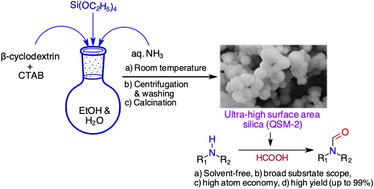
A sustainable room temperature synthesis of ultra-high surface area mesoporous silica material (1653 m2 g−1), designated as QSM-2, has been developed using tetraethyl orthosilicate, cetyltrimethylammonium bromide (CTAB), and β-cyclodextrin (β-CD) as the silicon source, structure directing agent, and additive, respectively. The process was optimised by varying key reaction parameters, including the amount of additive, reaction temperature and sonication, while maintaining a constant silica-to-surfactant ratio. Scale-up studies confirmed reproducibility at a 20-gram scale, highlighting the method's potential for large scale applications. The material with an ultra-high surface area was evaluated for the N-formylation of amines using formic acid as a benign C1 source, thereby enabling the indirect utilisation of CO2. This work presents a sustainable and selective protocol for converting a wide range of amines to the corresponding formamides under mild, solvent-free conditions, achieving excellent yields (up to 99%), and high selectivity (100%).
 Please wait while we load your content...


