


 PLATFORM UPDATE:

Development of novel biochar derived from Bacopa monnieri leaves for adsorptive removal of pendimethalin herbicide from binary and ternary pesticide mixture

Abstract
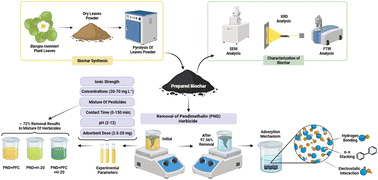
This study aims to develop and evaluate a sustainable biochar adsorbent derived from Bacopa monnieri leaves (BMBC) for the removal of the herbicide pendimethalin (PND) from aqueous solution and pesticide mixtures. The research focuses on studying the adsorption behavior, optimizing parameters, and elucidating the underlying mechanism. BMBC was synthesized through pyrolysis at 600 °C for 2 hours under limited oxygen conditions for the adsorptive removal of pendimethalin (PND) herbicide from an aqueous solution. The materials were characterized using XRD for elemental composition and crystallinity, SEM analysis for size & surface microstructure, and FTIR for identification of functional groups. BMBC exhibits an amorphous carbon structure with minor crystalline peaks (XRD), porous morphology (SEM), and oxygenated functional groups (FTIR). The PND removal experiments were conducted with various parameters, including initial concentration (30–70 mg L−1), contact time (0–150 min), pH (2–12), and absorbent dose (2.5–20 mg). Optimum removal (97.56%) was observed at an equilibrium time of 120 min, at a concentration of 40 mg L−1, pH 8, and a dosage of 5 mg, and ionic interactions were significantly enhanced in the presence of multivalent salts. The combination of profenocombi and PND was removed most effectively (73%) compared to other pesticide mixtures. The adsorption process, governed by pseudo-second-order kinetics (R2 > 0.98), suggested chemisorption. The Langmuir isotherm model represents high adsorption capacity (qm) of 82 mg g−1. The adsorption of PND onto BMBC occurs through hydrogen bonding, π–π stacking, electrostatic interaction, and pore filling. This study reveals the potential of BMBC as a highly effective, low-cost, and eco-friendly adsorbent for the removal of PND.
 Please wait while we load your content...


