


 PLATFORM UPDATE:


Combined mass spectrometry and computational analysis of cyanine dyes and their structural analogues

Abstract
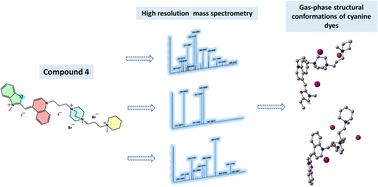
Cyanine dyes are widely used in biological imaging and labelling, yet the influence of halide counterions on their gas-phase stability and fragmentation remains poorly understood. Here we report a combined high-resolution mass spectrometry and computational study of asymmetric monomethine cyanine dyes bearing one to four positive charges, explicitly elucidating the mechanistic role of halide ions. We demonstrate that iodide uniquely promotes stable gas-phase self-assembly of cyanine dyes, forming higher-order clusters up to pentamers, whereas bromide and chloride do not. Tandem MS reveals pronounced halide-dependent fragmentation energetics, with iodide-containing complexes displaying enhanced stability and distinct product-ion distributions. These iodide-dye anion–π interactions support prior evidence of enhanced dye cell membrane permeability and mitochondrial accumulation. Density functional theory calculations rationalize these observations by identifying an SN2-like halide-assisted C–N bond cleavage mechanism, most favorable for iodide, which governs key fragmentation pathways. By integrating MSn experiments with computational analysis, this work moves beyond descriptive fragmentation studies and provides a mechanistic framework for halide-mediated behavior of cyanine dyes, with implications for mass spectrometric characterization of cyanine-labelled biomolecules and related imaging probes.
 Please wait while we load your content...


