


 PLATFORM UPDATE:


Enhancement of the heterogeneous photo-Fenton performance of GO/MIL-100(Fe)@Fe3O4 heterostructures for erythromycin degradation through accelerating Fe(ii) generation
 *a
*a
Abstract
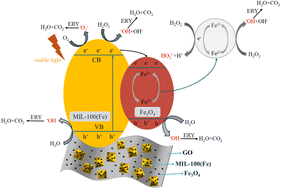
The slow rate of the Fe3+/Fe2+ cycle has decreased the efficiency of photo-Fenton technology for wastewater treatment. Here, a novel GO/MIL-100(Fe)@Fe3O4 heterostructure was constructed by growing Fe3O4 nanoparticles and MIL-100(Fe) onto GO, thus accelerating the Fe3+/Fe2+ cycle and improving catalytic activity, and it was used as a heterogeneous photo-Fenton catalyst for ERY degradation. The catalyst was fully characterized by TEM, XRD, Raman spectroscopy, XPS, N2 adsorption–desorption and UV-vis DRS. The influences of initial solution pH, H2O2 concentration and catalyst dosage on ERY degradation were investigated. Under optimal conditions (initial pH of 4.03, 10.0 mM H2O2, 0.1 g L−1 catalyst), the GO/MIL-100(Fe)@Fe3O4 + H2O2 + vis system removed 97.3% of ERY (0.1 mmol L−1) within 60 min, and the pseudo-first-order rate constant was 0.0575 min−1. Furthermore, the catalyst showed favorable stability, maintaining excellent catalytic activity even after 4 cycles. A possible degradation mechanism of ERY was proposed based on the results of characterization, ERY degradation, and reactive species analysis. Fe3O4, MIL-100(Fe) and GO in the catalyst showed synergistic effects; the photo-induced electrons from MIL-100(Fe) could be immediately transferred to Fe3O4, promoting Fe3+ reduction to Fe2+ in the photo-Fenton reaction. GO in the catalyst could promote electron transfer from MIL-100(Fe) and organics to Fe3O4, significantly promoting the Fe3+/Fe2+ cycle.
 Please wait while we load your content...


