


 PLATFORM UPDATE:


Understanding phonon polaritons and epsilon-near-zero modes in sapphire nanocones across the broad Reststrahlen band (385–1050 cm−1)
 ab
Kiernan E.
Arledge,
bc
Vincent R.
Whiteside,
d
Jiangang
Ma,
e
Joseph G.
Tischler
bc
and
Binbin
Weng
*ab
ab
Kiernan E.
Arledge,
bc
Vincent R.
Whiteside,
d
Jiangang
Ma,
e
Joseph G.
Tischler
bc
and
Binbin
Weng
*ab
Abstract
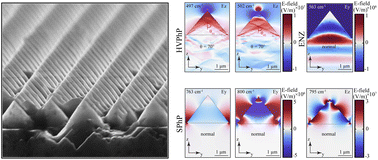
Tailoring light–matter interactions is crucial for advancing nanophotonics. Surface phonon polaritons are promising candidates for enhanced light–matter interactions due to their efficient, low-loss light confinement. In this work, we experimentally investigate the Reststrahlen bands in sapphire across the infrared spectrum, spanning ω = 385–1050 cm−1. We extended this investigation to nanocone-patterned sapphire resonators, with specific attention to its in-plane and out-of-plane permittivity components. Infrared spectroscopy and full-wave simulations revealed a range of optical excitations, including three surface phonon polaritons with quality factors as high as 40 ± 1, two hyperbolic volume phonon polaritons with quality factors as high as 83 ± 4, and one epsilon-near-zero mode with a quality factor of 122 ± 8 across the various Reststrahlen bands. Furthermore, confocal Raman scattering measurements showed enhanced Raman signals with maximum enhancement factors of 7.0 ± 0.6 on the nanostructured surface, indicating coupling between phonons and phonon–polaritons. Finally, finite element modeling of polarizability demonstrates good quantitative agreement with the measured results. This study is the first exploration of sapphire nanostructures and gives an in-depth understanding of phonon polaritons and epsilon-near-zero modes from nanocone-structured sapphire. The reported Raman enhancement attributed to coupling of phonon and phonon polariton modes holds promise for sensing through surface-enhanced Raman spectroscopy.
 Please wait while we load your content...


