


 PLATFORM UPDATE:


Unveiling the chemistry of polynuclear copper complexes: current synthetic strategies, properties and emerging applications

Abstract
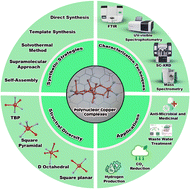
Polynuclear copper complexes (PNCCs), featuring an intricate interplay of multiple copper (Cu) ions, represent a highly diverse and complex field of coordination chemistry. In this review, we cover the synthesis, characteristics, factors affecting structural diversity, and applications of PNCCs. The synthesis methods, including direct synthesis, template synthesis, self-assembly, coordination-driven self-assembly, supramolecular approach and solvothermal methods, are described in detail. Various strategies to make stable Cu(I) and Cu(II) polynuclear networks and to control the nuclearity of PNCCs are documented in detail. The role of density functional theory (DFT) in the optimization of geometry and the prediction of the structure and reactivity of PNCCs is also explained. Physicochemical properties, including electronic, optical, geometrical, structural, and magnetic aspects, are discussed to highlight their fascinating chemistry. For the optimization of PNCC functionality, parameters such as the nature of the ligands and the coordination number of the Cu ions are explored. The potential biomedical applications of PNCCs, particularly due to their binding ability to DNA (opening new windows for cancer treatment) and magnetic properties (opening new avenues for applications in molecular electronics), are also discussed. Additionally, the roles of PNCCs in catalysis, the large-scale separation of C2 hydrocarbons (C2H2) at the industrial level, and the development of new materials (such as vapochromic compounds for organic light-emitting diodes) are highlighted. Besides, their roles in electrochemical CO2 reduction and H2 production and as photosensitizers for photocatalytic systems of CO2 reduction and H2 production are explored. All these fields require further exploration for their optimized and practical applications, as discussed in this review.
- This article is part of the themed collection: 2026 Reviews in RSC Advances
 Please wait while we load your content...


