


 PLATFORM UPDATE:

Versatile mixed-matrix membranes based on AMCD-ZIF and PVC for sustainable water remediation

Abstract
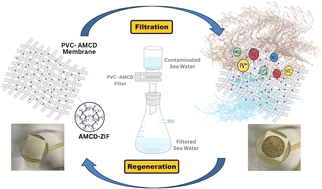
Heavy metal ions and inorganic anions in water sources pose serious environmental and health hazards, necessitating versatile and scalable treatment solutions. In this study, we employ a mixed-matrix membrane based on amine-carboxamide-modified zeolitic imidazolate frameworks (AMCD-ZIF) embedded in electrospun polyvinyl chloride (PVC) nanofibers for the removal of diverse water pollutants. The incorporation of AMCD into PVC nanofibers had been previously optimized for the removal of organic dyes and crude oil from water. Building on this optimized hybrid membrane, we extend its application to the removal of toxic heavy metals and inorganic anions. The functionalized membranes exhibited high adsorption capacities—up to 1666.7 mg g−1 for Pb(II), 400 mg g−1 for Ag(I), and 666.7 mg g−1 for Cd(II)—and demonstrated preferential uptake of Pb(II) in competitive metal systems. Under rapid filtration conditions, the membranes achieved comparable removal efficiencies to batch systems within just 5 minutes for heavy metals. Removal of anionic contaminants such as nitrate, nitrite, sulfate, phosphate, and total nitrogen from real contaminated water collected from Ain El Mreisseh was also investigated. Under rapid filtration conditions, the membranes achieved high removal efficiencies of the anions within 10 minutes: 99.2% for nitrate, 98.6% for nitrite, 95.3% for total nitrogen, 84.6% for sulfate, and 66.8% for phosphate. Additionally, the membranes maintained moderate performance across four regeneration cycles. These results highlight the scalability, reusability, and multifunctionality of the PVC-AMCD membrane as an effective platform for water purification, targeting organic dyes, solvents, crude oil removal, in addition to heavy metals and anionic contaminants investigated in this study.
 Please wait while we load your content...


