


 PLATFORM UPDATE:


Engineering ofloxacin bioavailability through spray-dried HPMC and xanthan gum-based solid dispersions: enhanced solubility and therapeutic efficacy

Abstract
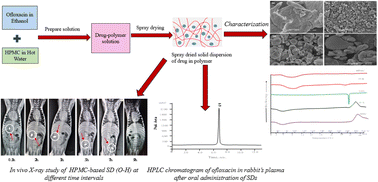
This study explores the enhancement of oral bioavailability, dissolution rate, and solubility of weakly water-soluble fluoroquinolone antibiotic, ofloxacin (OFL), by solid dispersion (SD) formulation prepared using the spray drying technique. Hydrophilic polymers; hydroxypropyl methylcellulose (HPMC) and xanthan gum (XNG) were used as carriers. FT-IR spectroscopy indicated hydrogen bonding between OFL and the polymer's backbone. DSC and PXRD analyses revealed a transformation from the crystalline to the amorphous state. SEM images revealed reduced particle size and changed surface morphology, which are favorable for solubility improvement. The in vitro drug release studies, performed in simulated gastric conditions (pH 6.8) showed a significant improvement in the drug release, 97.88% and 82.34% for HPMC-based (O–H) and XNG-based (O–X) SDs, respectively, as compared to only 59.2% for unprocessed OFL. Further, in vivo, kinetics reported in a validated HPLC-UV method in rabbits showed an impressive Cmax (O–H: 4.33 µg mL−1; O–X: 4.12 µg mL−1; OFL: 1.8 µg mL−1) and prolonged t1/2 (8 h vs. 5 h). Thus demonstrating a significant enhancement in bioavailability in the rabbit model. The SDs produced with HPMC and XNG represent a promising strategy to improve the solubility and in vivo performance of OFL, which may translate to improved therapeutic efficacy.
 Please wait while we load your content...


