


 PLATFORM UPDATE:

Theoretical exploration of As-based mixed halide double perovskites A3AsI6 (A = K, Rb, and Cs) for photovoltaics applications using a DFT approach

Abstract
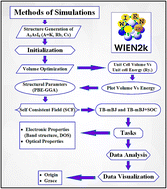
In this study, we explore the structural, electronic, optical, and elastic features of environmentally friendly lead-free mixed-halide double perovskites with the general composition A3AsI6 (A = K, Rb, and Cs), which are comprehensively analyzed using density functional theory (DFT). Our calculations reveal that the optimized lattice constants increase from 12.42 Å for K3AsI6 to 12.99 Å for Cs3AsI6, which is consistent with the progressive enlargement of the alkali metal ionic radii. To evaluate the electronic band structures, the Tran–Blaha-modified Becke–Johnson (TB-mBJ) potential was applied, with and without incorporating spin–orbit coupling (SOC), to achieve reliable estimations of the band gaps. The results reveal a consistent trend of decreasing band gap energies: 2.763 eV (mBJ) and 2.566 eV (mBJ + SOC) for K3AsI6 (indirect), 2.821 eV (mBJ) and 2.607 eV (mBJ + SOC) for Rb3AsI6, and 2.829 eV (mBJ) and 2.621 eV (mBJ + SOC) for Cs3AsI6. The density of states analyses further clarify the orbital contributions to the occupied and unoccupied bands. Elastic constants (Cij) confirm the mechanical stability of the materials, while Poisson's and Pugh's ratios indicate brittle behavior. Moreover, the calculated Debye temperatures suggest that K3AsI6 could better withstand thermal stresses induced by lattice vibrations than its Rb and Cs analogues. The optical characteristics, such as the dielectric function ε(ω), absorption coefficient α(ω), reflectivity R(ω), and refractive index n(ω), were comprehensively examined, revealing robust interactions with incident electromagnetic radiation. These comprehensive results underscore the potential of A3AsI6 (A = K, Rb, and Cs) double perovskites as viable candidates for next-generation optoelectronic applications, particularly in environmentally benign, lead-free technologies.
 Please wait while we load your content...


