


 PLATFORM UPDATE:


Room-temperature Suzuki–Miyaura polycondensation of aryl dichloride monomers enabled by “large-but-flexible” Pd-NHC precatalysts

Abstract
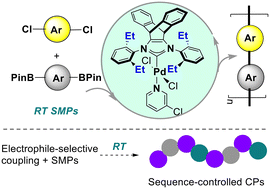
Dibenzobarrelene-based N-heterocyclic carbenes (NHCs) offer tunable steric and electronic properties, making them attractive ligands for Pd catalysis. Herein, we report a family of “large-but-flexible” Pd-NHC precatalysts that enable room-temperature Suzuki–Miyaura polycondensations (SMPs) of sterically hindered and electronically challenging aryl dichlorides. Key features include 2,6-diethylphenyl-substituted NHCs and 3-chloropyridine, which cooperatively promote C–Cl activation. Structural and variable-temperature-NMR analyses reveal suppressed CAr–N bond rotation and a conformationally adaptive ligand environment. The system affords high-molecular-weight π-conjugated polymers with broad monomer scope and good solubility. Significantly, it achieves electrophile-selective coupling of aryl chlorides to construct sequence-defined polymers, offering a more practical alternative to traditional nucleophile-based strategies. Mechanistic studies suggest a dynamic ligand exchange equilibrium that stabilizes the active Pd(0) species. These findings establish a robust and versatile platform for low-temperature polycondensation of aryl dichlorides.
 Please wait while we load your content...


