


 PLATFORM UPDATE:


Anisotropy deformation behavior of multi-layer black phosphorus
 ab
and
Yanquan
Geng
*a
ab
and
Yanquan
Geng
*a
Abstract
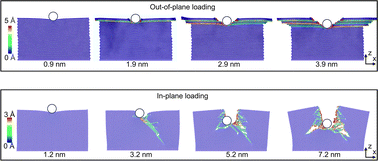
Black phosphorus (b-P) crystals, a type of two-dimensional (2D) van der Waals (vdW) semiconductor featuring excellent physical and chemical properties, have been reported to demonstrate high machinability during the cutting process. However, the comprehension of the correlation between the deformation mechanism and mechanical properties remains insufficient. In this study, molecular dynamics (MD) simulations were carried out to explore the anisotropic deformation behavior of multi-layer b-P during the tensile and nanoindentation processes. Additionally, based on these simulations, the interlayer interaction during the slip and cleavage deformation processes was calculated using Density Functional Theory (DFT). These findings indicate that during the tensile process, irregular intra/interlayer crack propagation occurs along the zigzag orientation, whereas straight crack propagation takes place along the AC orientation. During the indentation process, in-plane loading gives rise to brittle fracture behavior with cracks along specific orientations, while out-of-plane loading results in notable interlayer slip plastic deformation. The plastic deformation characteristics of the material under out-of-plane loading can be ascribed to the lower interlayer sliding energy and higher cleavage energy, which renders interlayer sliding dominant during the deformation process. The research findings offer a theoretical foundation for understanding the anisotropic mechanical response of multilayer b-P in device applications and serve as a technical reference for the mechanical machining processes.
 Please wait while we load your content...


