


 PLATFORM UPDATE:


Seaweed-derived hierarchical porous carbon for high-rate performance supercapacitors
Abstract
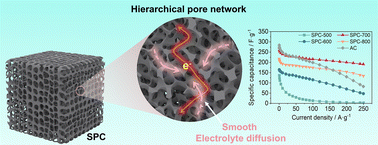
To address the issues of slow ion transport and insufficient rate performance in commercial activated carbon (AC) due to its micropore-dominated structure, this work successfully constructed a porous carbon material (SPC) featuring an interconnected hierarchical pore network of macropores, mesopores, and micropores. This was achieved using renewable seaweed as the precursor and environmentally friendly NaHCO3 as the activator through high-temperature chemical activation. This unique structure enables a synergistic mechanism of macroporous rapid diversion, mesoporous directional guidance, and microporous efficient storage, fundamentally optimizing ion transport kinetics. Benefiting from this design, the SPC electrode exhibited outstanding rate performance, maintaining a capacitance retention of 70.2% (191 F g−1) at a high current density of 250 A g−1, significantly outperforming AC (29.0%, 82 F g−1). Symmetrical supercapacitors assembled with SPC achieved an energy density of 27.1 Wh kg−1 and a power density of 47 450 W kg−1 in organic electrolytes. This work not only provides a novel design approach for developing high-rate performance supercapacitor electrode materials but also demonstrates a green and sustainable preparation pathway.
 Please wait while we load your content...


