


 PLATFORM UPDATE:


Bamboo fiber-derived carbon bridge g-C3N4 for efficient photocatalytic degradation of tetracycline
 *a
Yan
Zhou
*a
and
*a
Yan
Zhou
*a
and
Abstract
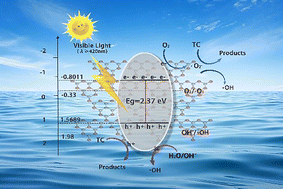
Fully utilizing bamboo fiber resources for achieving carbon bridge g-C3N4 to improve its photocatalytic effect remains challenging. In this study, a series of carbon-doped g-C3N4 were successfully designed and prepared through a bamboo fiber molecular assembly strategy and used as highly efficient photocatalysts for the degradation of tetracycline. Taking tetracycline (TC) as a model pollutant, the photocatalytic efficiency of carbon-doped g-C3N4 was significantly enhanced. Among them, the carbon-doped g-C3N4 material (labeled as CCN-2.5) shows the best photocatalytic performance with the fastest photocatalytic TC degradation rate. The degradation rate is 4.16 times that of the original g-C3N4. After five cycle experiments, CCN-2.5 still exhibits high stability and high catalytic activity. This study led to the development of a low-cost and green method for preparing C-doped g-C3N4 from bamboo fiber resources, enriching and advancing the scientific connotation and applications of bamboo fiber.
 Please wait while we load your content...


