Issue 8, 2026

Reversible supramolecular self-assembly via a deprotonation-protonation strategy

Abstract

A sulphonamide-based boranil probe (BS-1) is rationally designed and synthesized to demonstrate the formation of a reversible supramolecular self-assembly via a deprotonation-protonation strategy. Upon the formation of this self-assembly in the presence of sodium hypochlorite in DMSO, the probe exhibits a significant redshift in the UV absorption (406 to 422 nm) and emission (472 to 592 nm) spectra. BS-1 demonstrates a high sensitivity (LOD = 110 nM), rapid response (< 10 s), and fluorescence switching. The SEM observations collectively demonstrate a clear morphological transformation of BS-1 from linear microsheets to cubic J-aggregates, driven by deprotonation-induced self-assembly through charge-assisted hydrogen bonding.
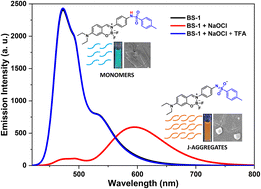
Graphical abstract: Reversible supramolecular self-assembly via a deprotonation-protonation strategy

Supplementary files

Article information

Article type
Paper
Submitted
16 Nov 2025
Accepted
27 Jan 2026
First published
02 Feb 2026

New J. Chem., 2026,50, 3806-3812

Reversible supramolecular self-assembly via a deprotonation-protonation strategy

V. S. Marde, D. S. Sharada and A. K. Mishra, New J. Chem., 2026, 50, 3806 DOI: 10.1039/D5NJ04473A

To request permission to reproduce material from this article, please go to the Copyright Clearance Center request page.

If you are an author contributing to an RSC publication, you do not need to request permission provided correct acknowledgement is given.

If you are the author of this article, you do not need to request permission to reproduce figures and diagrams provided correct acknowledgement is given. If you want to reproduce the whole article in a third-party publication (excluding your thesis/dissertation for which permission is not required) please go to the Copyright Clearance Center request page.

Read more about how to correctly acknowledge RSC content.

Social activity

Spotlight

Advertisements