


 PLATFORM UPDATE:


Synergistic corrosion inhibition of propargyl alcohol and Schiff base on the corrosion of mild steel in hot HCl solution

Abstract
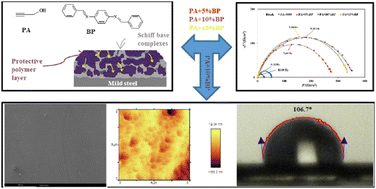
The widespread use of mild steel (MS) in construction necessitates effective corrosion inhibitors when it is subjected to an aggressive environment. Despite producing toxic vapors during acid pickling and well simulation, propargyl alcohol (PA) is widely used as a highly effective synergistic corrosion inhibitor for these conditions. Multicomponent inhibitor formulations can be developed to reduce production costs and PA toxicity, thereby protecting MS from corrosion in hot, concentrated acidic environments. Thus, this study investigated the synergistic corrosion inhibition effect on MS in 12% HCl at 80 °C using an organic formulation composed of PA and a Schiff base synthesized from 1,4-phenylenediamine and benzaldehyde (BP). The formulation efficiency was assessed using weight loss, potentiodynamic polarization (PDP), and electrochemical impedance spectroscopy (EIS). The results proved that the mixture of PA + BP effectively inhibited the acid corrosion of the MS, when PA was replaced by BP at 5%, 10%, and 15%. A maximum of 94.4% inhibition efficiency was achieved using 4500 ppm PA + 500 ppm BP (PA + 10% BP). In addition, the formation of the protective layer produced on the MS surface was studied using SEM/EDX, XRD, DR-FTIR, AFM and contact angle measurement. It was shown that the mixture of PA + 10% BP in 12% HCl solution decreased the mild steel's surface roughness as measured by AFM, and increased hydrophobicity as determined by water contact angle measurements. EDX calculations and DR-FTIR indicated the presence of an organic layer covering the steel surface. Furthermore, the corrosion inhibition mechanism was discussed.
 Please wait while we load your content...


