


 PLATFORM UPDATE:


Tuning the electrochemical properties of NiCo2S4 through Mn doping and g-C3N4 integration for next-generation supercapacitors

Abstract
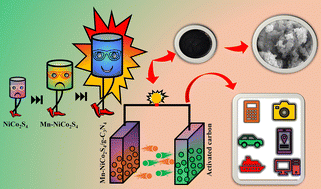
Various metal sulfides have been investigated as electrode materials for supercapacitors. NiCo2S4 is a popular material in this field due to its high electrical conductivity and theoretical capacity. Various approaches are used to improve its performance. We provide a hydrothermal approach for synthesizing a Mn–NiCo2S4/g-C3N4 composite material. The addition of Mn provides more electroactive sites, resulting in improved specific capacitance and improved cycling stability. The g-C3N4 has a 2D π-conjugated planar layer structure similar to graphene, which allows for more active sites for faradaic reactions, increases the surface area, improves electrical conductivity, and prevents NiCo2S4 aggregation. The Mn–NiCo2S4/g-C3N4 composites have a high specific capacitance of 940.2 F g−1 at 1 A g−1. The asymmetric supercapacitor (ASC) using Mn–NiCo2S4/g-C3N4 as the positive electrode and activated carbon as the negative electrode achieves a high energy density (ED) of 36.36 Wh kg−1 and a power density (PD) of 749.8 W kg−1. It also has excellent cycling stability, with 88.33% retention after 10 000 cycles. These findings show that Mn–NiCo2S4/g-C3N4 has significant promise for developing high-performance electrode materials for supercapacitors.
 Please wait while we load your content...


