


 PLATFORM UPDATE:


Hetero-bimetallic complexes of pyridine-/pyrazine-2-carboxamide ligands: synthesis, structure, redox properties and magnetism†

Abstract
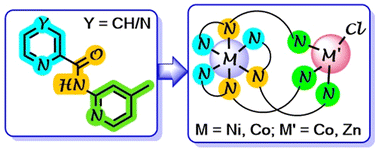
Utilizing deprotonated forms of pyridine-/pyrazine-2-carboxamide ligands, the synthesis and structural characterization of hetero-bimetallic complexes [NiII(Lpy)3CoIICl]·6H2O (1), [NiII(Lpy)3ZnIICl]·xH2O (2), [CoII(Lpz)3ZnIICl]·H2O (3), [CoIII(Lpz)3ZnIICl](PF6)·(C2H5)2O·CH3CN·H2O (4), [NiII(Lpz)3CoIICl]·H2O (5), and [NiII(Lpz)3ZnIICl]·H2O (6) have been achieved. Structural studies reveal that six-coordinate Co(II), Co(III), and Ni(II) are supported by three bidentate Lpy(−) or Lpz(−) ligands utilizing deprotonated pyridine-2-carboxamide or pyrazine-2-carboxamide providing three pyridine/pyrazine N and three amidate N and such a situation in turn places three pyridine nitrogens of the 4-methyl-2-aminopyridine units to act as a tridentate N3 facial-capping ligand to hold other bivalent metal ions Co(II) or Zn(II). The fourth coordination site around the distorted tetrahedral bivalent metal ion is completed by a chloride ion originating from the Co(II) or Zn(II) starting material. A facile CoIII/CoII redox process in 3 and 4 and NiIII/NiII redox process in 1, 2, 5, and 6 have been observed. It has been demonstrated that by changing the donor site of pyridine N to pyrazine N, the oxidation state of the metal ion in both Co(II) and Co(III) could be readily accessed in the synthesis of 3 and 4, attesting that a pyrazine stabilizes the lower oxidation state of a metal ion better than a pyridine. Solid-state magnetic susceptibility measurements on 1 and 5 in the range of 2–300 K revealed weak antiferromagnetic coupling between the six-coordinate Ni(II) (S = 1) and four-coordinate Co(II) (S = 3/2) centers.
 Please wait while we load your content...


