


 PLATFORM UPDATE:


Composition controlled metallic Sn-doped MoS2 nanosheets for a flexible and wearable temperature sensor
 *a
and
*a
and
Abstract
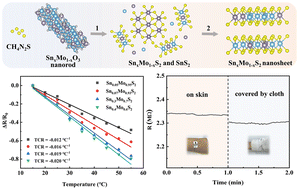
Two-dimensional (2D) MoS2 demonstrates significant potential for applications in flexible electronic sensing devices due to its unique physical and chemical properties and ultrathin layered structure. Metallic 1T phase MoS2 is inherently metastable and tends to transform into the thermodynamically stable semiconducting 2H phase. Atomic doping can regulate the crystal phase of the MoS2 and carrier concentration, and enhance the material stability. In this study, 2D metallic Sn-doped MoS2 (SnxMo1−xS2) nanosheets were successfully synthesized via a hydrothermal method. The film resistance of SnxMo1−xS2 can be precisely controlled to change by two orders of magnitude through the precise regulation of the Sn doping concentration. The Sn0.4Mo0.6S2-based temperature sensor displayed a negative temperature coefficient of resistance of −0.020 °C−1, exhibiting an 82% improvement compared with 1T MoS2. Meanwhile, the temperature-sensing performance of Sn0.4Mo0.6S2 nanosheets is superior to that of reported doped and un-doped TMDs and their composites. In addition, the TCR remained stable under different bending conditions owing to the special nanosheet structure. Therefore, the Sn0.4Mo0.6S2 sensor showed promising applicability for flexible and wearable human body temperature monitoring and activity tracking devices.
 Please wait while we load your content...


