


 PLATFORM UPDATE:


An eco-friendly K2NaInBr6 double halide perovskite as a next-generation absorber for perovskite solar cells: a DFT and SCAPS-1D study

Abstract
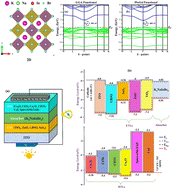
Environmental drawbacks of lead-based perovskite solar cells (PSCs) have driven growing interest in eco-friendly double halide compounds, notably K2NaInBr6. This study presents a comprehensive investigation of the structural, electronic, and optical properties of K2NaInBr6 using density functional theory (DFT), with the obtained results further employed to evaluate its potential as an absorber layer in solar cell applications. Structural analysis confirms the cubic symmetry of K2NaInBr6, while its electronic band structure and density of states (DOS) indicate semiconductive behavior, with band gaps of 1.99 eV (PBE) and 1.89 eV (PBEsol). Evaluation of optical behavior from 0 to 12 eV, using PBEsol and PBE formalisms, indicates that the absorption coefficient, reflectivity, refractive index, dielectric function, optical conductivity, and energy loss collectively endorse the material as an excellent light absorber. The suitability of K2NaInBr6 for solar cell applications was tested by modeling a range of device architectures using SCAPS-1D. In the comparative study of 24 device structures, the ITO/SnS2/K2NaInBr6/Cu2O/Ni design exhibited superior performance, yielding a power conversion efficiency (PCE) of 21.9%, an open-circuit voltage (VOC) of 1.56 V, a short-circuit current density (JSC) of 15.92 mA cm−2, and a fill factor (FF) of 87.75%. Contour mapping was utilized to determine how absorber and ETL thicknesses affect fundamental photovoltaic responses. The investigation extends to analyzing the influence of eight LMCs (left metal contacts), series and shunt resistances, temperature variations, quantum efficiency (QE), capacitance–voltage (C–V) response, generation and recombination effects, Mott–Schottky characteristics, current density–voltage (J–V) behavior, and impedance characteristics on device performance. The extraordinary photon capture performance of the K2NaInBr6 perovskite highlights its importance for improving photovoltaic and optoelectronic devices.
 Please wait while we load your content...


