


 PLATFORM UPDATE:


Covalent surface functionalization of carbon nitrides: a case study of poly(heptazine imide)
 ab
Igor
Moudrakovski,
a
Saunak
Das,
a
Kathrin
Küster,
a
Sebastian
Bette
a
and
Bettina V.
Lotsch
*ab
ab
Igor
Moudrakovski,
a
Saunak
Das,
a
Kathrin
Küster,
a
Sebastian
Bette
a
and
Bettina V.
Lotsch
*ab
Abstract
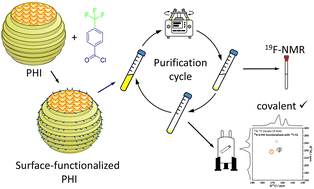
Surface functionalization of graphitic carbon nitrides has been demonstrated to promote catalytic properties but has rarely been investigated with the 2D carbon nitrides poly(heptazine imide) (PHI) and poly(triazine imide) (PTI) despite their potential for a variety of applications. This may originate from the chemically inert and hence unreactive character of carbon nitrides in conjunction with the lack of possibilities to verify the success of a post-synthetic covalent functionalization. Herein, we address these problems and mainly investigate the possibility of covalently functionalizing PHI with any desired organic molecule. A strategy of using fluorine-containing functionalizations to enable access to 19F NMR studies is utilized, which ensures the complete removal of unreacted functional groups (FGs) and provides an easy and reliable quantification of the functionalization afterwards. Screening experiments illustrate the necessity to increase the accessibility to the surface. Furthermore, a high yield can be achieved by using acyl chlorides as functionalization agents. In addition, the proof of covalent functionalization is provided by means of 2D NMR on 15N-enriched PHI modified with a 13C-enriched FG. Our study thus presents a general route to the covalent functionalization of PHI and opens up new perspectives for rationally adding desired functionality to polymeric carbon nitrides in general.
 Please wait while we load your content...


