


 PLATFORM UPDATE:


A study on interfacial structure design and thermal conductivity optimization of diamond/copper composites
 ac
Ruzhi
Wang
*a
ac
Ruzhi
Wang
*a
Abstract
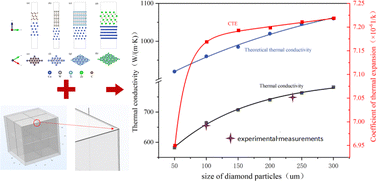
Diamond/copper composites have garnered significant interest due to their high thermal conductivity, playing a crucial role in next-generation high-density integrated electronic components. Currently, enhancing the interfacial bonding strength between diamond and the copper matrix through intermediate layers to improve composite thermal conductivity constitutes a major research focus in this field. However, the diamond/copper interfacial structure and its high thermal conductivity mechanisms remain unclear. To address this, this study employed first-principles calculations to investigate three interfacial structures: copper/zirconium carbide (Cu/ZrC), copper/titanium carbide (Cu/TiC), and copper/tungsten carbide (Cu/WC). Among these, the Cu/TiC interface was identified as having stronger binding ability for combining the copper matrix with diamond than Cu/ZrC and Cu/WC. Subsequently, the thermal conductivity performance of diamond/copper composites with the TiC interfacial layer was investigated using the finite element analysis (FEA) and the interfacial thermal resistance theory. This study systematically explored the effects of the diamond volume fraction, particle size, and interfacial layer thickness on the thermal conductivity and coefficient of thermal expansion of the composites. The results demonstrate that our computational findings closely match experimentally measured values: at diamond particle sizes of 100 µm and 230 µm, the simulated thermal conductivities of 664 W m−1 K−1 and 763 W m−1 K−1 align with experimental measurements of 654 W m−1 K−1 and 752 W m−1 K−1, respectively. Furthermore, the observed trends consistently correspond to experimental data, confirming that both thermal conductivity and the coefficient of thermal expansion decrease with the increasing interfacial layer thickness. And thermal conductivity and the coefficient of thermal expansion increase with increasing diamond particle size. Conversely, thermal conductivity increases when the coefficient of thermal expansion decreases with increasing diamond volume fraction. Our simulation results demonstrate excellent agreement with published experimental data and established trends. This study presents simulation approaches and fitting formulas for the thermal conductivity and coefficient of thermal expansion, providing theoretical guidance for the design, fabrication, and application of diamond/copper-based composite thermal management materials.
 Please wait while we load your content...


