


 PLATFORM UPDATE:


Large improvement in the charge storage performance of a CoSb2O6–reduced graphene oxide (rGO) composite – probing the role of rGO through experiments and theoretical analyses

Abstract
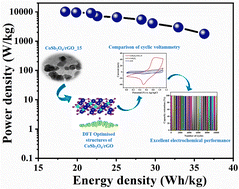
We present a detailed electrochemical comparison between cobalt antimony oxide (CoSb2O6) and its reduced graphene oxide (rGO) composite, prepared through a combination of hydrothermal and ultrasonic synthesis. The structural, morphological, and compositional properties of the as-synthesized material have been investigated through comprehensive characterization techniques. In a three-electrode configuration, the CoSb2O6/rGO composite exhibited a specific capacitance value of 1000 F g−1 at a mass-normalized current of 2 A g−1, which is at least 5-fold higher than that of pristine CoSb2O6 (i.e., 195.5 F g−1 at a mass-normalised current of 2 A g−1). It shows a high capacity retention of 93.18% over 3000 cycles. We have also tested a two-electrode symmetric device, fabricated from the CoSb2O6/rGO composite, which shows a specific capacitance of 227.79 F g−1 at a mass-normalised current of 1 A g−1. The CoSb2O6/rGO composite yields energy and power densities of 38.28 Wh kg−1 and 10.08 kW kg−1, respectively, and exhibits a cyclic stability of 98.54% even after 10 000 cycles. Furthermore, we have employed density functional theory simulations to elucidate the structure and electronic characteristics of pristine CoSb2O6 and CoSb2O6/rGO composite systems. The enhancement in the electronic states near the Fermi level, resulting from the charge transfer from rGO to CoSb2O6, indicates improved conductivity of the CoSb2O6/rGO composite system. The considerably lower diffusion energy barrier and enhanced quantum capacitance of CoSb2O6/rGO compared to CoSb2O6 contribute to the superior supercapacitance performance, which supports our experimental findings.
- This article is part of the themed collections: Celebrating International Women’s Day 2026: Women in Materials Advances and Supercapacitors for a sustainable energy future
 Please wait while we load your content...


