


 PLATFORM UPDATE:

Selective cellular uptake and cytotoxicity effects of fluorescent carbon dots: a comparative study in cancer and normal cells

Abstract
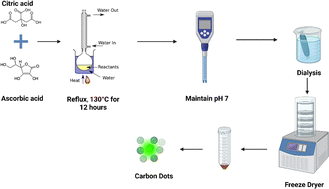
Cancer remains one of the most critical global health challenges. Early detection is crucial for effective treatment and improved patient survival. However, conventional diagnostic tools often struggle to identify cancer in its early stages due to limitations such as low sensitivity, high costs, and a reliance on tumor size. Additionally, commercial dyes used for imaging face challenges like poor water solubility, toxicity, instability, and high cost, making them expensive and imprecise in targeting early-stage tumors. In recent years, carbon dots (CDs) have emerged as promising fluorescent imaging probes thanks to their nanoscale size, adjustable surface properties, strong fluorescence, and excellent biocompatibility, which make them suitable for various biological applications, including bioimaging, drug delivery, and tissue engineering. In this study, green, fluorescent carbon dots (GCDs) were synthesized using citric acid and ascorbic acid as carbon sources through a reflux method at 130 °C for 12 hours. The prepared GCDs were characterized using dynamic light scattering (DLS), atomic force microscopy (AFM), high-resolution transmission electron microscopy (HR-TEM), UV-vis spectroscopy, fluorescence spectrophotometry, X-ray photoelectron spectroscopy (XPS), and Fourier-transform infrared (FTIR) analysis, including an assessment of their stability. We evaluated cellular uptake and cytotoxicity in both cancer and normal cell lines, finding that the resulting GCDs exhibited nanoscale size, strong photostability, and low toxicity. Importantly, we analysed the optical properties and stability of the GCDs and compared cellular uptake with fluorescein isothiocyanate (FITC), as well as the fluorescence intensity of both GCDs and FITC in normal and cancer cells. The GCDs were more significantly internalised by cancer cells (MDA-MB-231 breast cancer cells and HeLa cervical cancer cells) compared to normal cells (RPE1 retinal pigment epithelial cells, HEK293T human embryonic kidney cells, and NIH-3T3 mouse embryo cells). Additionally, we explored the potential of GCDs in zebrafish models. This selective uptake led to increased accumulation. In conclusion, our findings highlight the cost-effective and eco-friendly development of GCDs, which show promising potential for cancer bioimaging and theranostic applications.
 Please wait while we load your content...


