


 PLATFORM UPDATE:


Effect of ammonia borane thermal decomposition under different Ar fluxes on large-area boron nitride films for quantum photonic applications
 ab
Nicoleta
Nicoara,
a
Diego A.
Garzón,
a
James C.
Peters,
ab
Jana B.
Nieder,
a
Pedro
Alpuim,
a
Sascha
Sadewasser
*a
ab
Nicoleta
Nicoara,
a
Diego A.
Garzón,
a
James C.
Peters,
ab
Jana B.
Nieder,
a
Pedro
Alpuim,
a
Sascha
Sadewasser
*a
Abstract
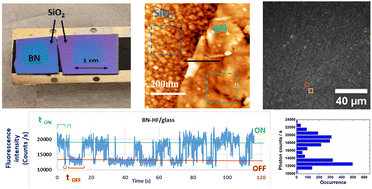
Hexagonal boron nitride (h-BN) has emerged as a promising 2D material. It has a wide band gap (∼6 eV), which can host numerous optically active structural defects. Here, a detailed investigation is presented on the growth of BN films using ammonia borane NH3BH3 (AB) powder as a precursor. The growth is performed via atmospheric pressure chemical vapor deposition (AP-CVD) where AB thermal decomposition under Ar flow is considered as a vital step for the deposition of high-quality BN. In this context, the AB pre-treatment step is tuned by testing two different Ar gas flow conditions: low flux (5 sccm), and high flux (95 sccm). BN thin films are grown and successfully transferred onto SiO2/Si, glass, and sapphire substrates using a wet chemical method. X-ray photoelectron spectroscopy shows similar surface chemical composition of the BN films. Large-area BN films (∼1 cm2) with a thickness of 7 nm are confirmed by atomic force microscopy and X-ray reflectivity. From the transmittance and reflectance curves, and respective Tauc plots, the estimated band gaps are in the range of 3.73 to 5.02 eV. Fluorescent spots observed in BN thin films in the wavelength range of 520 to 696 nm exhibit blinking events. This fluorescence intermittency observed via total internal reflection fluorescence microscopy (TIRF), indicates that AP-CVD grown BN may foster defects that can act as single photon emitters (SPEs). These studies will enable the optimization of h-BN production, aiming to get high-quality SPEs in h-BN for future quantum technology application.
 Please wait while we load your content...


