


 PLATFORM UPDATE:


Fine-tuning the surface coverage of niobium oxide on platinum catalysts and its impact on the oxygen reduction reaction
 a
Jennie I.
Eastcott,
a
Abhinav
Parakh,
a
Michael T. Y.
Paul,
a
Matthew W.
Bilton,
a
Byron D.
Gates
*a
a
Jennie I.
Eastcott,
a
Abhinav
Parakh,
a
Michael T. Y.
Paul,
a
Matthew W.
Bilton,
a
Byron D.
Gates
*a
Abstract
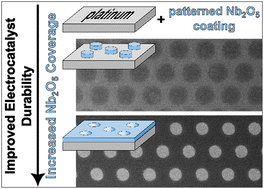
Platinum electrocatalysts coated with an ultrathin film of niobium oxide, which were prepared with a fine-tuned surface coverage, were evaluated for their influence on the oxygen reduction reaction. A series of ultrathin (<10 nm thick), patterned coatings of niobium oxide were prepared on planar platinum substrates using a combination of atomic layer deposition, photolithography, and wet-chemical etching techniques. Atomic layer deposition enabled a high degree of control over the thickness of the niobium oxide coating. Niobium oxide is a corrosion-resistant material that can improve the stability of electrocatalysts. A balance is sought, though, between the stabilizing benefits of applying a metal oxide coating to electrocatalysts and the possible blockage of catalytically active sites. The study presented herein pursues a method to precisely tune the surface coverage of niobium oxide coatings using techniques to pattern these coatings on a platinum electrocatalyst. The prepared catalysts were evaluated using a range of electrochemical and microscopy techniques. It was found that catalysts with higher coverages of niobium oxide had a higher initial resistance towards the oxygen reduction reaction but significantly outperformed the long-term performance of the uncoated, pristine platinum catalyst.
 Please wait while we load your content...


